Microbiology in an AI Era
How a free specialist platform combines a curated scientific knowledge hub, semantic retrieval, evidence reranking, and large language models to support microbiological research and learning.
Microbiology does not suffer from a shortage of information. It suffers from fragmentation.
A seemingly focused question about a microbial process may require evidence from microbial ecology, genomics, molecular biology, biotechnology, medicine, bioinformatics, or bioprocess engineering. Relevant studies may be distributed across hundreds of journals, use different terminology, examine different organisms, and reach conclusions that depend strongly on sample type, experimental conditions, and analytical choices.
Traditional literature databases remain indispensable, but they usually return lists of records rather than integrated explanations. General-purpose AI systems can explain complex subjects fluently, but their answers may combine established knowledge, outdated information, unsupported inference, and occasionally incorrect references without clearly distinguishing among them.
AskMicrobe was developed to address this gap.
It is a free AI assistant specialized in microbiology and designed to connect natural-language questions with a curated body of scientific literature. Its purpose is not to replace primary papers, bibliographic databases, experiments, or expert judgment. Instead, it provides a conversational evidence interface that helps users formulate questions, identify relevant studies, compare methods, organize scientific knowledge, and determine what should be investigated next.
Beyond a general chatbot
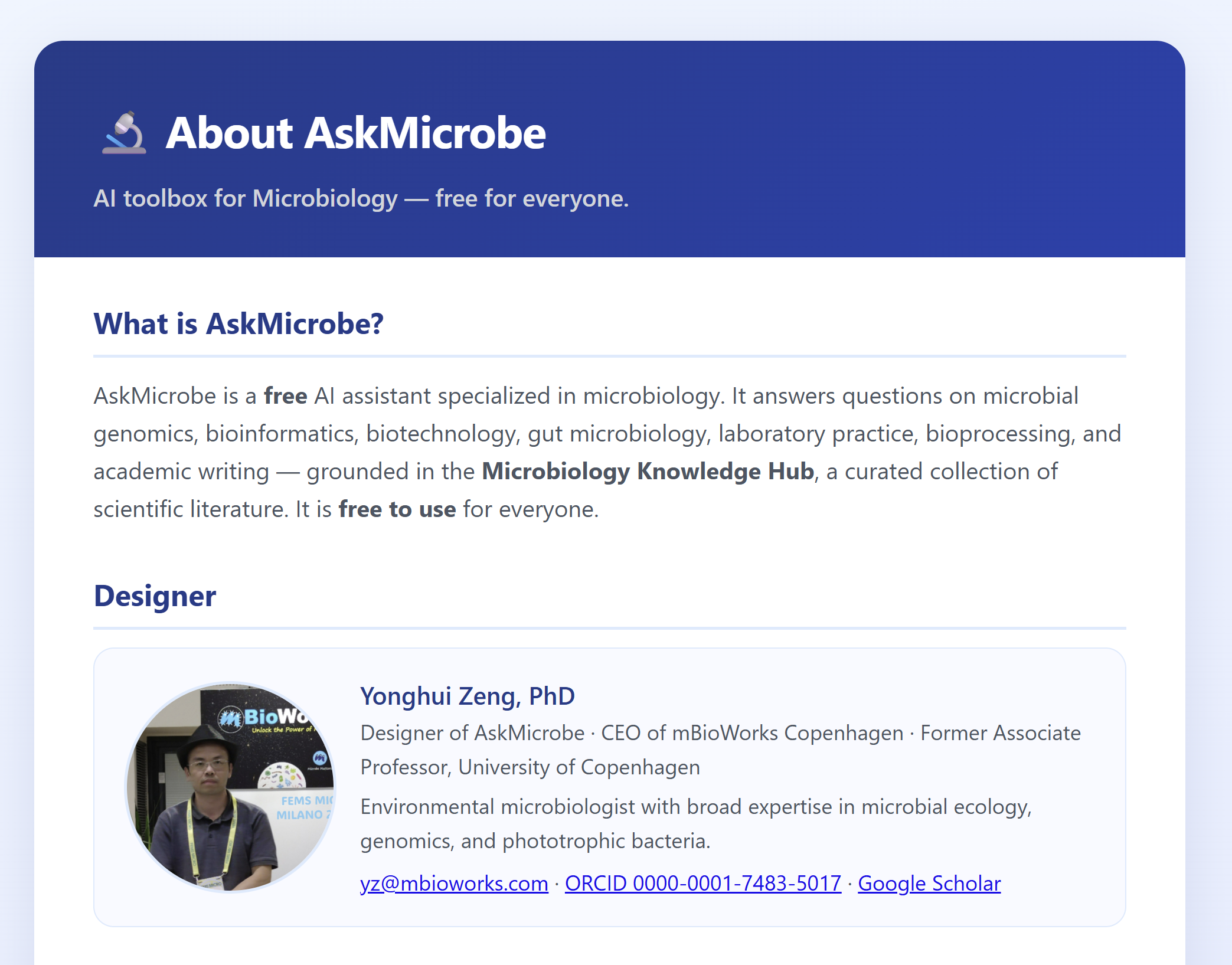
AskMicrobe is developed by mBioWorks Copenhagen and designed by environmental microbiologist Yonghui Zeng, PhD. It covers microbial genomics, bioinformatics, biotechnology, gut microbiology, laboratory practice, bioprocessing, academic writing, and related areas of microbial science. The service is free to use and is supported by the broader mission of making microbiological knowledge more accessible.
The defining component of the platform is the Microbiology Knowledge Hub, a curated collection of journal literature and textbook content used to support scientific answers.
This distinction is important.
A conventional language model generates answers largely from statistical representations learned during training. It may possess extensive microbiological knowledge, but users cannot always determine which statements are supported by identifiable publications, which come from general model knowledge, and which are newly generated interpretations.
AskMicrobe instead applies a retrieval-augmented architecture. For questions that require scientific evidence, the system searches its specialized knowledge base, selects potentially relevant passages, ranks them according to their relevance to the question, and supplies the strongest evidence to the language model before the answer is written. Sources are then presented for further inspection when literature from the Knowledge Hub contributes to the response.
AskMicrobe is therefore better understood not simply as an AI that “knows microbiology,” but as a tool that helps users move from a microbiological question to relevant evidence.
A brief history of AskMicrobe
AskMicrobe began as an early experiment in combining conversational AI with local scientific retrieval.
The first version was released on 26 June 2023, using a local retrieval-augmented generation system together with GPT-3.5-turbo. At that stage, the central concept was already present: rather than relying exclusively on the model’s internal knowledge, the system would retrieve microbiology-specific information to support its answers.
In January 2024, a beta version based on a fine-tuned GPT-3.5 model was evaluated. The experiment was discontinued because the resulting answer quality was not considered adequate. This was an important design decision. Instead of assuming that additional model training would automatically produce a reliable scientific assistant, development returned to the broader problem of prompt design, evidence retrieval, and answer grounding.
AskMicrobe was upgraded to GPT-4 in March 2024, accompanied by a revised prompting strategy. In May 2024, AskMicrobe v2 introduced GPT-4o, a more developed retrieval-augmented workflow, and the Microbiology Knowledge Hub as the platform’s dedicated scientific foundation.
The Knowledge Hub received a major literature update in October 2025. In May 2026, the system moved to GPT-5.2. AskMicrobe v3 was released on 30 August 2026, introducing a redesigned interface and a substantially updated Knowledge Hub. The current technical description states that answer generation is powered by GPT-5.6.
This history reveals a broader lesson about scientific AI. Improving a domain-specific assistant is not simply a matter of replacing one language model with a newer one. The usefulness of the system also depends on the quality of its knowledge collection, retrieval strategy, evidence selection, prompting, citation design, and interface.
AskMicrobe’s development has therefore moved progressively from a model-centered prototype toward a more structured evidence-centered system.
Why domain-specific AI
Microbiology is unusually well suited to a specialist AI architecture because the field is both broad and context dependent.
The same concept may be described differently across microbial ecology, clinical microbiology, industrial biotechnology, and genome informatics. Taxonomic names change. Reference databases are revised. Sequencing technologies evolve. Bioinformatics tools introduce version-dependent behavior. A method that performs well for an isolated bacterial genome may be unsuitable for a complex microbiome, a low-biomass environmental sample, an RNA virus, or a fungal community.
Many apparently simple statements are therefore conditional.
“Long-read sequencing improves taxonomic resolution” may be broadly true, but its practical value depends on read accuracy, sequencing depth, marker choice, database quality, and the taxonomic group under investigation.
“Shotgun metagenomics provides functional information” is also broadly true, but the interpretation depends on gene annotation quality, community complexity, extraction bias, host contamination, assembly performance, and whether detected genes can be assigned confidently to particular organisms.
A domain-focused system can be designed to recognize these qualifications more consistently. It can search sources selected specifically for microbiology and its neighboring disciplines rather than drawing indiscriminately from the wider internet.
Specialization does not eliminate error. A retrieval-augmented system can still retrieve the wrong passage, omit an important paper, overgeneralize from an abstract, or misinterpret a technical result. Its advantage is not guaranteed correctness. Its advantage is a more transparent and potentially more useful route from question to evidence.
The general technical design
AskMicrobe is a retrieval-augmented generation system, commonly abbreviated as RAG, but its architecture is more structured than a single search followed by a single model response.
At a high level, the workflow can be represented as:
User question → contextual query reformulation → semantic retrieval → candidate reranking → evidence assembly → answer generation → references and quality indicators
The current platform describes this process as a six-stage pipeline.
1. Understanding and reformulating the question
Scientific questions are often incomplete when considered in isolation.
A user may ask:
“Would this workflow also work for archaea?”
The phrase “this workflow” has meaning only in the context of the previous conversation. The system therefore examines the current question together with recent dialogue and rewrites it into a more explicit search query.
This step can resolve pronouns, expand abbreviations, identify the relevant organism or method, and translate conversational language into terminology more likely to occur in scientific publications.
For example, a discussion about “measuring the real number of bacteria rather than percentages” may be reformulated into concepts such as absolute microbial abundance, quantitative microbiome profiling, spike-in standards, internal calibrants, flow-cytometric normalization, or microbial load estimation.
AskMicrobe currently uses a smaller, faster model for this query-understanding stage. For tasks that do not require scientific retrieval—such as grammar correction, translation, or straightforward rewriting—the system can deliberately bypass the literature-search pipeline.
2. Semantic retrieval from a vector database
The reformulated query is processed by an embedding model. An embedding is a numerical representation of the semantic content of a piece of text.
AskMicrobe currently identifies Qwen3-Embedding-8B as the model used for this stage. The resulting query vector is compared with precomputed vectors representing material in the Microbiology Knowledge Hub.
This is different from a conventional keyword search.
A keyword search primarily identifies documents containing the terms entered by the user. Semantic retrieval attempts to find passages that express related concepts even when the wording differs. This is particularly valuable in microbiology, where equivalent or overlapping concepts may be described differently across subfields or historical periods.
The vector database returns a set of candidate passages that are semantically related to the question. Uploaded files can also be divided into passages and searched through the same general mechanism.
3. Reranking the candidate evidence
Semantic similarity alone is not sufficient.
A passage can be broadly related to microbial community analysis without directly addressing the user’s question about extraction bias, low-biomass contamination, or species-level taxonomic resolution.
AskMicrobe therefore applies a second selection stage using bge-reranker-v2-gemma, described as a cross-encoder reranker. Rather than comparing independently generated vectors, a cross-encoder examines the question and each candidate passage together. It then assigns a score reflecting how directly that passage contributes to the requested answer.
This distinction is central to the architecture:
- Semantic retrieval asks, “Is this passage conceptually related?”
- Reranking asks, “Does this passage actually help answer this particular question?”
Only the strongest candidates are retained for the next stage.
4. Building a structured evidence block
The selected passages are assembled into an evidence package for the answer-generating model.
AskMicrobe limits the amount of evidence contributed by any single source. The purpose is to reduce the risk that one paper crowds out all other perspectives and dominates the answer simply because several highly similar passages were retrieved from it.
This evidence-diversity mechanism is particularly relevant for comparative or contested questions. A scientifically useful answer about sequencing technologies, taxonomic classifiers, extraction methods, antimicrobial resistance, or microbial ecology should not normally depend on one publication alone.
The evidence block does not constitute a systematic review. It is a targeted collection selected for relevance to the immediate question.
5. Generating the scientific answer
The final language model receives the user’s question, relevant conversational context, the assembled evidence, and AskMicrobe’s scientific writing instructions.
The current platform identifies GPT-5.6 as the answer-generation model. The model uses the retrieved material where relevant and organizes it into an explanation, comparison, workflow, or other requested format.
The language model remains responsible for synthesis. It must connect information from different passages, adapt the level of explanation, resolve differences in terminology, and produce a coherent response.
This is also where new errors can be introduced. Even when the retrieved passages are correct, the model may overstate a conclusion, omit an experimental qualification, or infer more than the evidence supports. Retrieval improves the evidentiary basis of an answer, but it does not remove the need for critical evaluation.
6. Presenting sources and quality indicators
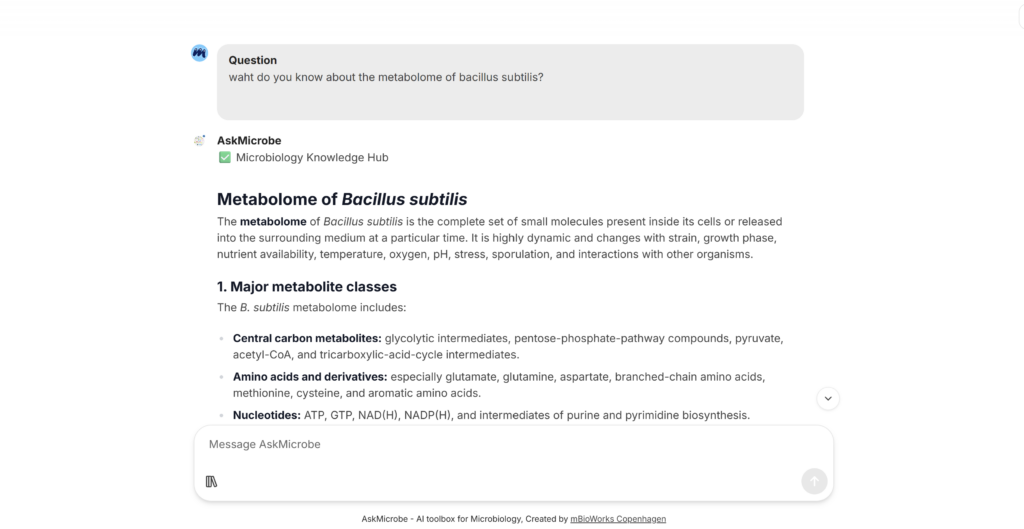
When Knowledge Hub literature contributes to an answer, AskMicrobe places a check-mark indicator at the top of the response and provides a Further Reading section. References may include the article title, authors, publication year, journal, original source link, and DOI when available. Every answer also includes a reminder that important information should be independently checked.
The check mark should be interpreted correctly.
It means that retrieved literature contributed to the response. It does not mean that every sentence has been independently validated, that the cited publications support every formulation exactly, or that no relevant evidence was omitted.
A literature-grounded answer is more traceable than an unsupported answer, but it is not automatically equivalent to peer review.
Microbiology Knowledge Hub
The Microbiology Knowledge Hub is the curated literature foundation behind AskMicrobe.
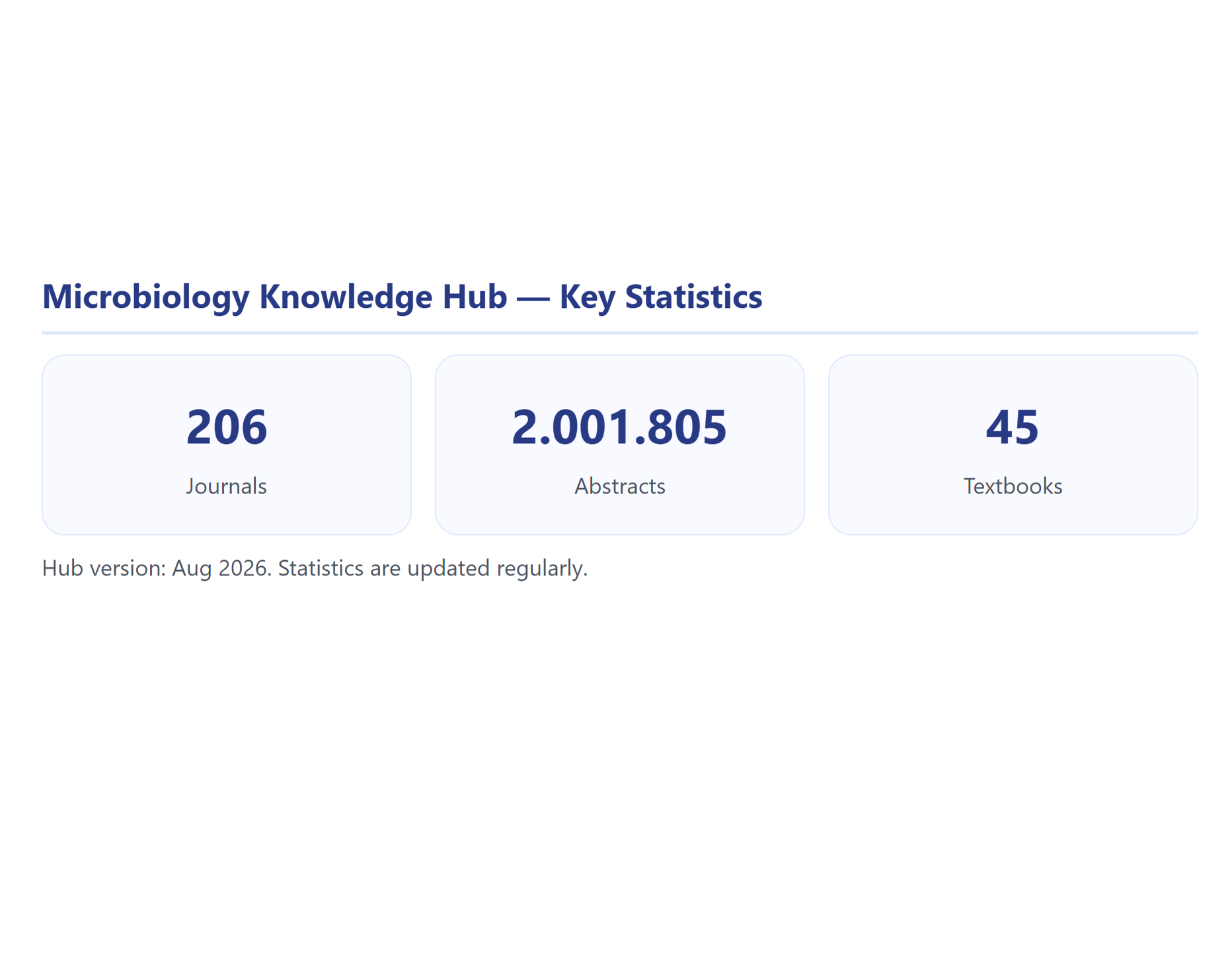
The current system searches more than 2 million pre-embedded article abstracts and textbook digests. The listed collection covers more than 200 journals and 45 textbooks, spanning microbial ecology, genomics, clinical microbiology, infectious disease, virology, mycology, parasitology, biotechnology, bioinformatics, food microbiology, environmental science, and laboratory methodology.
The combination of journals and textbooks serves two different purposes.
Journal literature is important for recent findings, specialized methods, comparative evaluations, emerging technologies, and active scientific controversies. Textbooks are often more useful for established concepts, terminology, historical context, fundamental mechanisms, and systematic explanations.
A question about a recently introduced metagenomic assembler may benefit primarily from journal literature. A question about bacterial conjugation, central metabolism, fungal morphology, or viral replication may benefit from the more structured treatment commonly found in textbooks.
The collection is curated rather than exhaustive. This is a strength because it allows the platform to focus on material considered relevant to microbial science. It is also a limitation because a relevant publication may not be included.
Moreover, much of the journal collection consists of article abstracts rather than complete papers. Abstracts are useful for identifying studies and summarizing headline findings, but they frequently omit:
- detailed experimental conditions;
- full statistical analyses;
- negative or inconclusive results;
- subgroup findings;
- software parameters;
- supplementary methods;
- and limitations discussed only in the full text.
AskMicrobe should therefore be used to discover, compare, and organize literature—not to avoid reading the original publications.
Where AskMicrobe can help
Enter an unfamiliar research area
Researchers regularly need to work beyond their principal specialization. A microbial ecologist may need to understand clinical antimicrobial-resistance terminology. A molecular biologist may need to evaluate metagenomic assembly. A biotechnology team may need to assess community sequencing for a fermentation process.
AskMicrobe can provide an initial conceptual map by identifying the main terminology, biological mechanisms, experimental strategies, technical biases, areas of agreement, and unresolved questions.
This can make subsequent searching in PubMed, Web of Science, Scopus, Google Scholar, or specialized databases more focused and efficient.
Compare experimental approaches
Method selection is rarely a matter of choosing the newest technology. The appropriate method depends on the biological question, sample type, expected biomass, required resolution, available controls, cost, and downstream analysis.
AskMicrobe can help compare areas such as:
- amplicon sequencing versus shotgun metagenomics;
- short-read versus long-read sequencing;
- relative versus absolute microbial abundance;
- culture-dependent versus culture-independent methods;
- reference-based versus de novo genomic analysis;
- different DNA extraction procedures;
- or different taxonomic and functional annotation strategies.
The most useful output is not merely a table of advantages and disadvantages. It is an explanation of when, why, and under what assumptions each difference matters.
Design or review bioinformatics workflows
Microbial bioinformatics consists of interdependent analytical decisions.
Read filtering affects assembly. Assembly affects annotation. Contamination influences taxonomic classification. Reference-database quality constrains biological interpretation. Software defaults may be inappropriate for a particular organism, sequencing platform, or sample type.
AskMicrobe can help organize a workflow according to:
- scientific objective;
- required inputs;
- major processing stages;
- quality-control criteria;
- expected outputs;
- alternative approaches;
- decision points;
- and likely failure modes.
This can be valuable during project planning, pipeline review, teaching, or communication between laboratory scientists and bioinformaticians.
Any proposed workflow should still be checked against current software documentation, benchmark studies, representative test data, and suitable positive and negative controls.
Interpret documents and uploaded material
Uploaded documents can be divided into passages and searched in relation to a user’s question. This creates several practical applications:
- discussing a paper or technical report;
- interpreting a laboratory protocol;
- identifying unclear scientific statements;
- comparing uploaded material with general microbiological knowledge;
- reviewing a manuscript structure;
- or explaining technical content for another audience.
This functionality should be used with appropriate data-governance precautions, particularly when files contain unpublished or confidential material.
Support scientific writing
AskMicrobe can assist with scientific writing tasks such as restructuring an introduction, clarifying a methods section, reducing repetition, standardizing terminology, improving English, or translating technical material.
For literature-based writing, the researcher remains responsible for verifying every reference, reading the original sources, distinguishing evidence from interpretation, and ensuring that the final text accurately represents the underlying research.
Ask better scientific questions
The quality of an AI-assisted answer depends strongly on the quality of the question.
A broad prompt such as:
Tell me about full-length 16S sequencing.
may produce a useful introduction, but it does not define the biological application, comparison method, evidence period, or expected depth.
A stronger prompt would be:
Compare Illumina V3–V4 amplicon sequencing with full-length 16S rRNA gene sequencing for bacterial community profiling. Discuss taxonomic resolution, primer bias, sequencing error, reference-database dependence, low-biomass contamination, and quantitative limitations. Prioritize methodological studies published since 2021. Separate well-supported conclusions from context-dependent findings and unresolved questions, and provide verifiable references and DOI information where available.
A useful prompt structure is:
Research object + scientific context + requested task + evidence constraints + desired output format
After receiving the initial answer, the user can ask more critical follow-up questions:
- Which conclusions are directly supported by the retrieved publications?
- Which statements are your synthesis or inference?
- What experimental conditions might explain disagreement among studies?
- Which papers should be read in full before making a methodological decision?
- What evidence is missing?
- What result would falsify the proposed explanation?
These questions turn the interaction from passive answer generation into active scientific reasoning.
Practicals and Tips
How to interpret the output critically
An AskMicrobe response may contain several types of scientific content.
Retrieved evidence comes from passages selected from the Knowledge Hub. It is the most traceable component, but the source may still have been interpreted incorrectly.
General model knowledge may contribute when the retrieved evidence does not fully cover the question. Such information may be correct, but its provenance is less explicit.
Scientific synthesis combines information from multiple sources into a broader explanation. Synthesis can be valuable, but it may introduce assumptions not stated in any single publication.
Inference or recommendation appears when the system proposes an interpretation, experimental strategy, or analytical workflow. These outputs should be treated as decision-support suggestions or hypotheses rather than experimentally validated conclusions.
Users should therefore examine not only whether references are present, but also whether the references support the precise claim being made.
Scientific limitations cannot be solved by fluent language
AskMicrobe can accelerate literature-supported reasoning, but it cannot correct weaknesses in the underlying science.
If the available literature is incomplete, contradictory, biased, or based on small datasets, the answer will inherit those limitations. If a reference database is poorly curated, AI cannot produce reliable taxonomic assignments from it. If an experiment lacks adequate controls, a polished explanation cannot rescue the data.
AskMicrobe should not replace:
- full-text reading;
- inspection of methods and supplementary information;
- current software documentation;
- systematic literature searches;
- pipeline validation;
- statistical review;
- experimental confirmation;
- or specialist clinical, biosafety, legal, and regulatory advice.
Its strongest role is to support scientific reasoning, not to act as an autonomous scientific authority.
Privacy and responsible use
Before submitting files or research information, users should review the current AskMicrobe Privacy Policy. The public policy page states that use of the website is subject to that policy.
More generally, online AI services should not be assumed to be appropriate repositories for confidential information. Researchers should avoid submitting identifiable patient data, unpublished patent-sensitive sequences, proprietary customer information, passwords, access credentials, or material covered by nondisclosure agreements unless its use has been formally approved under the relevant institutional and contractual requirements.
The same caution applies to draft manuscripts, grant applications, internal reports, and commercially sensitive experimental results.
Privacy is not a secondary concern added after the scientific analysis. It is part of responsible research practice.
Where AskMicrobe belongs in the scientific workflow
AskMicrobe is most useful between the initial research question and the deeper investigation.
It can help move a user from:
“I need to understand this subject”
to:
“These are the relevant concepts, competing explanations, methodological choices, uncertainties, and publications I should examine.”
Its natural position in the workflow is:
Question formulation → preliminary evidence retrieval → conceptual organization → method comparison → identification of primary sources → expert evaluation and validation
It should not occupy the final position as the authority that determines what is scientifically true.
For students, AskMicrobe can lower the initial barrier to reading specialist literature. For researchers, it can accelerate interdisciplinary exploration and method evaluation. For biotechnology teams, it can help structure technical discussions and identify questions requiring experimental validation. For educators, it can demonstrate how scientific questions can be refined, tested, and challenged.
The platform’s long-term value does not depend only on the particular language model used at a given time. Models will continue to change.
The more durable contribution is the architecture: connect a microbiological question to a curated knowledge base, retrieve relevant evidence, rerank that evidence, organize it into a usable context, produce a readable synthesis, and expose the sources so that a human can verify the result.
Asking better questions—not outsourcing scientific judgment
The most productive way to use AskMicrobe is not to ask it to replace the microbiologist.
It is to ask it to help the microbiologist think more efficiently.
That means using the system to locate evidence, uncover terminology, compare alternatives, reveal assumptions, identify uncertainty, and formulate the next question. It also means checking references, reading original studies, validating proposed workflows, and rejecting answers that are not adequately supported.
Scientific AI is most valuable when it makes reasoning more traceable, not merely when it makes text easier to generate.
AskMicrobe represents one approach to that goal: a free, specialist, literature-grounded AI assistant designed around the information needs of modern microbiology.